October is Blindness Awareness Month, and I thought this would be a good opportunity to discuss something I’ve been reflecting on recently: why working with my guide dog, Eve, is more efficient for me than traveling with a white cane.
Before I go any further, I want to make one thing clear. I am not saying that guide dogs are better than white canes. Both are valuable mobility tools, and choosing between them is a personal decision. What works for one blind or visually impaired individual may not work for another.
For me, the decision comes down to my lifestyle, physical abilities, and how much energy I use getting from one place to another.

Lindsay and Eve walking down a path on a college campus.
My Journey From a White Cane to a Guide Dog
Before Eve, I used a white cane for 12 years. I considered myself a confident, independent, and relatively fast cane traveler.
For years, I thought about applying for a guide dog but wasn’t sure whether it was the right decision. It wasn’t until a friendship encouraged me to take that leap that I finally decided to pursue it.
I’ve shared more about that experience in my previous post, What I Wish I Could Tell My 16-Year-Old Self….

Lindsay at YouTube Space LA holding her white cane.
When Eve and I began our partnership in July 2023, I quickly realized that working with a guide dog was going to change how I traveled.
It wasn’t that I suddenly became independent because I had a guide dog. I was already independent with my cane. Instead, Eve provided me with a more efficient way to travel.
Here are four reasons why.
1. Traveling at a Faster Pace
One of the biggest differences I’ve noticed between cane travel and guide dog travel is my walking speed.
As someone who works on a university campus, travels between students as a Teacher of Students with Visual Impairments, and frequently attends conferences, I spend a significant amount of time moving between locations.
When using my cane, I am responsible for detecting obstacles, identifying what they are, and determining how to navigate around them. Even though I am a confident cane traveler, this often requires me to slow down.
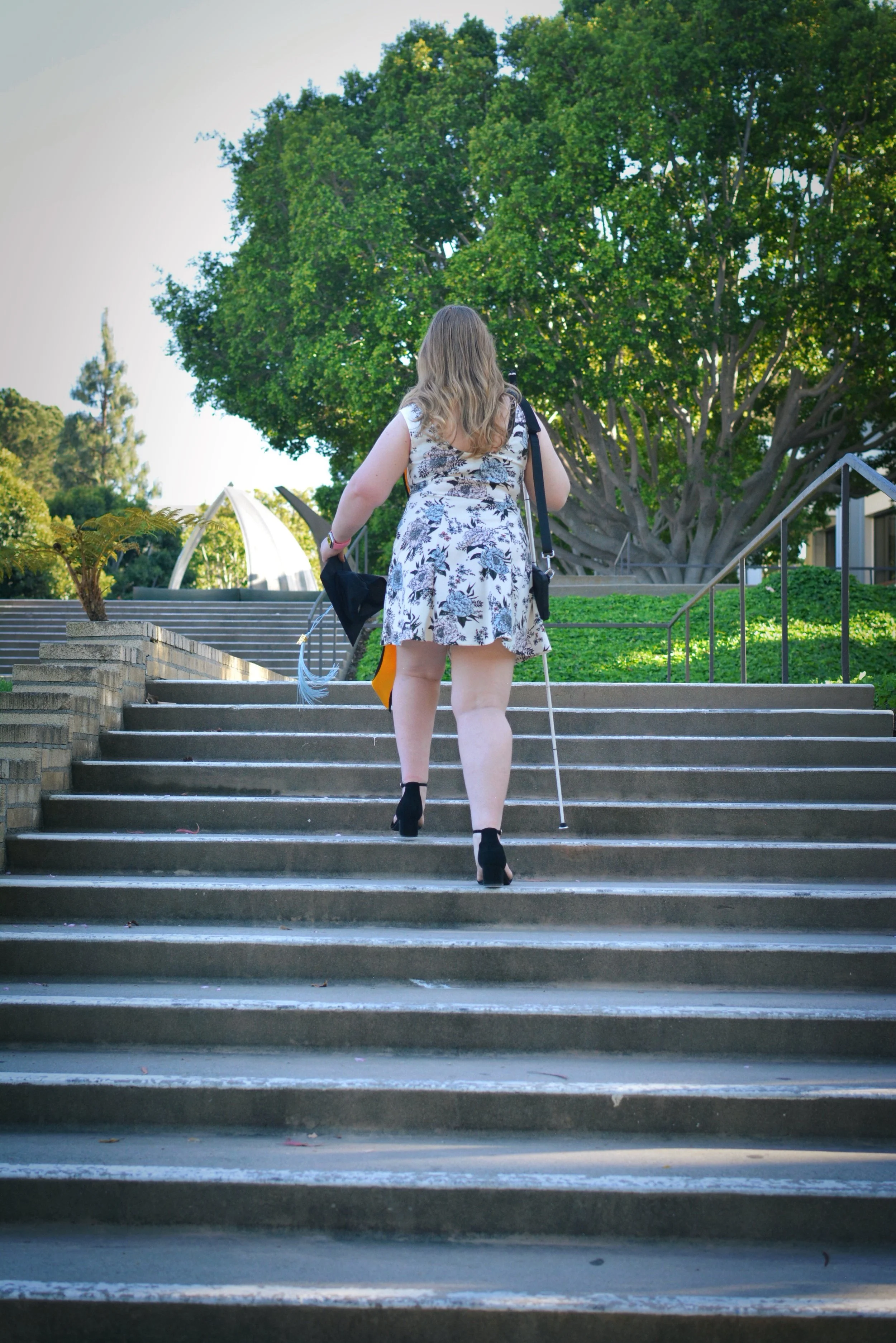
Lindsay Walking up a staircase using her white cane while carrying a braille display and graduation cap.
With Eve, much of that immediate obstacle avoidance is handled by her. She can guide me around people, objects, and other obstacles while maintaining a relatively consistent pace.
This makes a significant difference when I’m trying to navigate a busy campus or move through an airport.
I’ve often joked that working Eve feels like racing a horse, while returning to cane travel feels like walking through quicksand.
There have even been times when I’ve described myself as feeling like a snail!
Of course, this doesn’t mean all cane travelers are slower than guide dog handlers. This is simply how the two methods compare for me.
2. Being Able to Carry Things More Easily
Another major advantage of working with Eve is the ability to carry things more easily.
In addition to being visually impaired, I have cerebral palsy, which affects my left side. My left wrist was fused when I was younger, limiting my ability to rotate it.
Because of this, using a white cane effectively with my left hand is extremely difficult. I typically use my cane in my right hand.
When working with Eve, however, I can hold her harness in my left hand, leaving my right hand available for other tasks.
This is particularly helpful when carrying groceries, managing rolling luggage, or transporting materials between students and classrooms.
I’ve discussed some of these adaptations in my previous blog post, Working a Guide Dog with CP and a Visual Impairment.
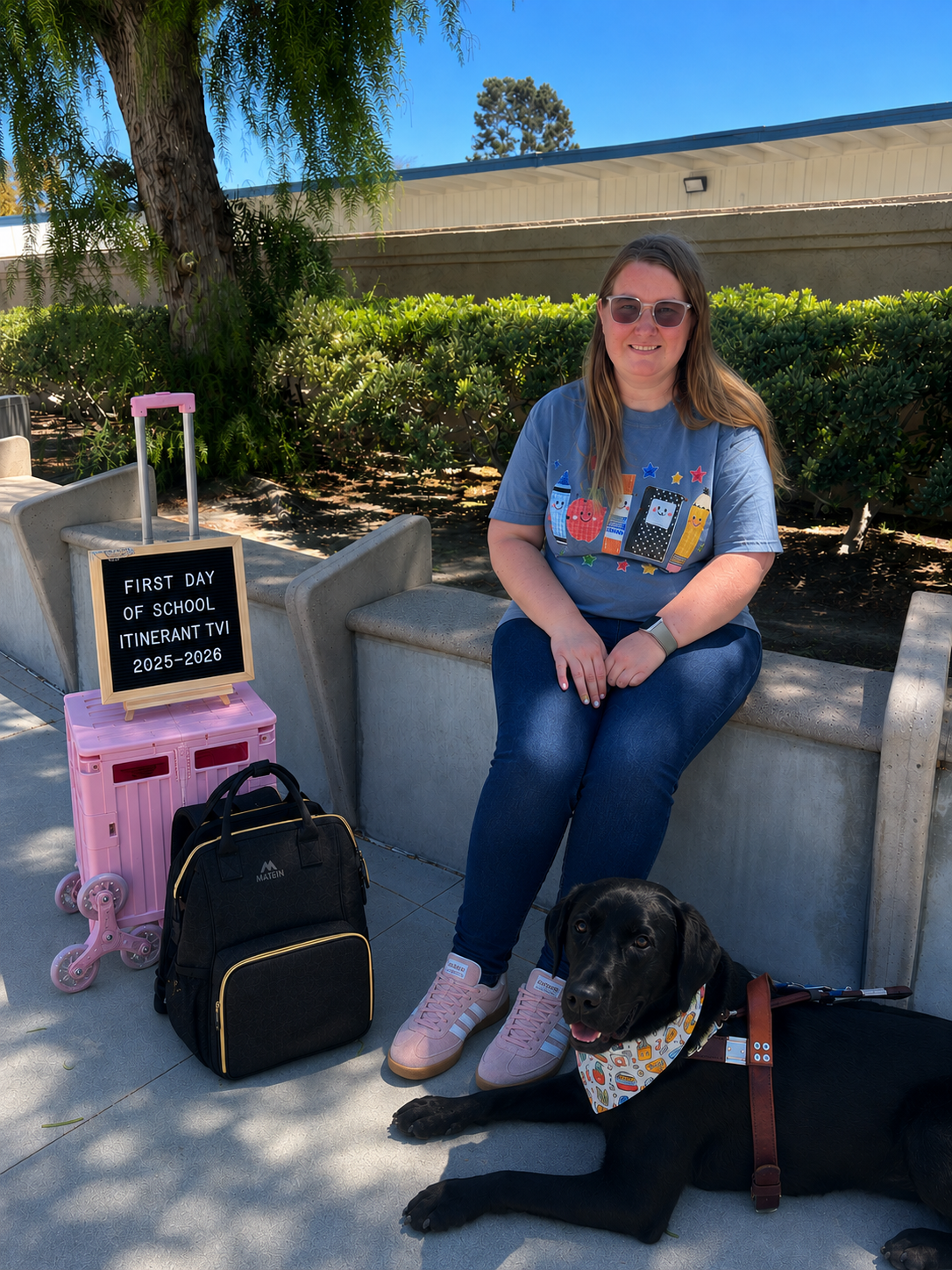
Lindsay sitting on a bench with her teaching supplies next to her. Eve is also laying on the oposite side in harness with a school themed bandana on.
Recently, during the National Federation of the Blind’s Teachers of Tomorrow program, I participated in an activity that reminded me just how challenging it can be to manage multiple items while traveling with a cane.
As part of the activity, I needed to carry a tray and a cup while navigating with my cane.
I ended up holding my cane cautiously in my left hand, positioning it in front of the tray toward the center of my body. I also used my left hand to help stabilize the empty cup while my right hand supported the tray.
Was I successful? Sort of. I still managed to lose a cup at one point.
Was it efficient? Not particularly!
The experience reinforced how much easier certain everyday activities have become since I started working with Eve.
I’ll be sharing more about my experiences throughout the yearlong Teachers of Tomorrow program in a future blog post.
3. Reduced Mental Fatigue and Cognitive Load
One of the differences I didn’t fully appreciate until I began working with Eve was how much mental energy cane travel required.
When traveling with a cane, I’m constantly processing information about my surroundings.
I have to identify obstacles, determine how to move around them, maintain my orientation, and make decisions about where I’m going.
Although these skills became second nature after years of practice, they still require significant concentration.
With Eve, I remain responsible for knowing where I’m going, giving directions, and making safe travel decisions. However, she handles much of the immediate obstacle avoidance.
That allows me to focus more of my attention on other aspects of traveling.
This is especially helpful during long workdays when I’m moving between students, attending meetings, or navigating busy environments.
When I return to cane travel for an extended period, I notice the difference almost immediately.
I feel as though I’m using considerably more mental energy to accomplish the same tasks.
Again, this is my personal experience. Other blind travelers may find cane travel less mentally demanding or may prefer the information their cane provides.
4. Remembering Familiar Routes and Destinations
Another benefit of working with Eve is her ability to remember familiar routes and destinations.
Over the years, she has become familiar with many of the places we travel regularly.
On my university campus, she remembers routes between buildings and frequently visited locations.
When traveling, she has also demonstrated an impressive ability to remember certain destinations, including hotel elevators and relief areas.
One experience that particularly impressed me happened at the Salt Lake City airport.
Despite not having traveled through that airport in approximately three years, Eve remembered how to navigate between the A and B gates.
Of course, this doesn’t mean I can simply tell Eve where I want to go and expect her to figure everything out.
I am still responsible for understanding our route, maintaining orientation, and making decisions about when it is safe to cross streets.
However, having a guide dog who remembers familiar destinations can make traveling significantly more efficient.
Finding What Works Best for Me
Although I clearly prefer working with Eve, that doesn’t mean I’ve abandoned my white cane or the skills I developed during the 12 years I used it as my primary mobility tool.
There have been times when Eve has been sick or otherwise unable to work, and I’ve needed to return to full-time cane travel.
Those experiences have reminded me that I am still a capable cane traveler, even if it takes me longer to get where I’m going.
I also recognize that someday, whether that’s in the near future or much further down the road, I will eventually need to transition to a successor guide dog.
Ideally, I hope I won’t have to spend an extended period traveling exclusively with my cane between partnerships. However, I understand that circumstances can change, and I know I have the skills to manage independently if necessary.
Why I Still Believe in Carrying a White Cane
Even with a guide dog, carrying a cane is still important. You never know when your dog might become ill, need a break, or encounter a situation where switching to your cane makes sense.
I’ll admit that I have a bad habit of forgetting mine, and there have been times when that has gotten me into trouble!
Having my cane with me gives me another way to travel independently when plans change unexpectedly.
As a Teacher of Students with Visual Impairments, carrying and using my cane also helps me model something I want my students to understand: both tools are valuable.
Although traveling with Eve often feels faster and requires less mental energy for me, my cane skills remain essential.
I want my students to feel confident using the tools that meet their individual needs in different situations. Whether they choose to travel with a cane, a guide dog, or eventually learn to use both, the important thing is having the skills and confidence to travel independently.
Independence Is About Having Choices
Working with a guide dog also comes with responsibilities that shouldn’t be overlooked.
There is daily care, ongoing training, veterinary appointments, and the responsibility of ensuring that your dog remains healthy and comfortable while working.
A guide dog is not necessarily the right choice for everyone, just as a white cane may not be everyone’s preferred mobility tool.
For me, working with Eve has provided a way to travel that better accommodates my physical needs, busy schedule, and personal preferences.
Eve didn’t give me independence that I didn’t already have. She gave me a different, and for me, more efficient way to exercise that independence.
And while I may joke about feeling like a snail when I’m using my cane, I know that both tools have an important place in my life.
Ultimately, independence isn’t about which mobility tool you use. It’s about having the skills, confidence, and choices to travel in a way that works best for you.