What Parents of Visually Impaired Kids Should Know about the Guide Dog Lifestyle
Many parents of blind and low vision children have the hope that someday their child may be able to work a guide dog or several throughout their lifetime. What many parents do not consider is that their is a lot that goes into having a guide dog. It is not just your child who is now needing vision services through school, so they should get a guide dog.
I share these things in this post because my parents often thought because I received services throughout school related to my vision that I would qualify for a guide dog as soon as I turned 16, but that was farther from the truth. There were many things that I had to learn and experience before getting Eve. If there was a list of things that I could share with parents, these are the things I would tell them:
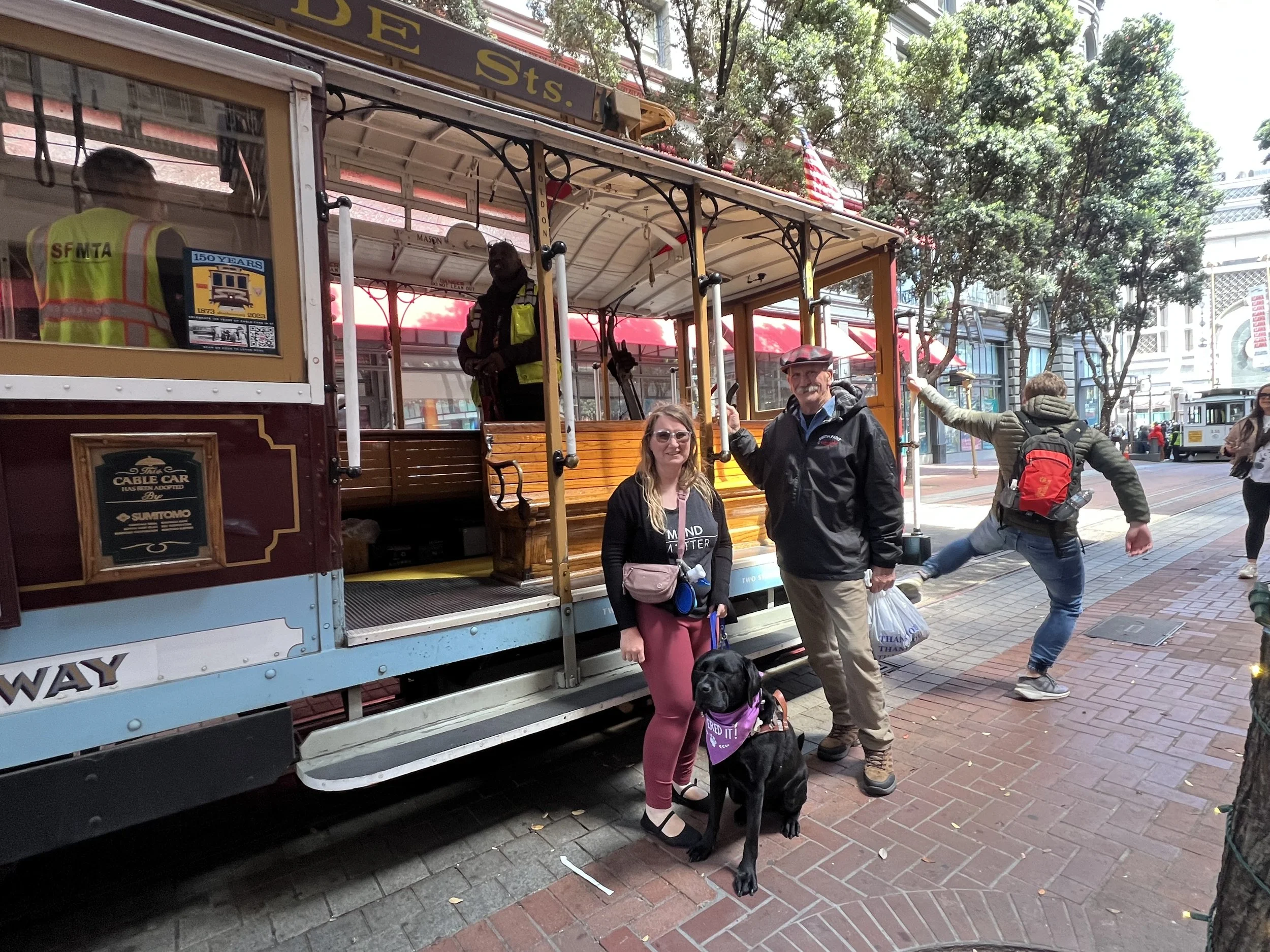
Lindsay, Eve, and her dad standing together in front of a trolley car in San Francisco.
It’s not just your child turning 16 and has a visual impairment therefore they should get a guide dog: Although your child is 16 and qualifies based on age, do they have the maturity level to care for a dog including; feeding, taking them out, grooming, playing with, etc? I mention these things because it’s a big responsibility to take care of another living being at such a young age.
Your child needs to make the decision for themselves to get a guide dog: I know as a parent on the surface it sounds like a great idea for your child to have a guide dog as it will make you feel better as they get older and potentially start traveling on their own, but the important thing to keep in mind is that it is the child’s choice to have a guide dog either at 16 or later as this dog will always be with them Don’t pressure them about the topic or building their skills to get one, if the lifestyle is meant for them and they really want it they will build the skills they need. As a parent support them in whatever choice they make.
Length of guide dog programs: If your child does make the choice to get a guide dog there are different lengths of programming offered from two weeks to a month in a residential setting on the individual campus. Depending on if your child is a minor some programs may ask that a parent is present on campus during the entirety of your child’s class. The main reason some programs require this is to ensure the safety of the minor. There are home training options for some programs, but again it should be your child’s choice whether they choose that option.
There is programming for youth about guide dogs: Throughout the country there is programming to expose blind and low vision children to the concept of a guide dog and all the things that come with having a guide dog. Some examples of this programing are:
Guide dogs for the Blind’s Camp GDB: Helps children that are blind or visually impaired learn what it takes to live the guide dog lifestyle. Those who attend camp are ages 14 to 17. Attending this camp is free of charge to those who attend.
The Seeing Eye Seminar for Youth Program SESY: Like Camp GDB, SESY is free of charge to attendees and is a week long program. Those who attend are between 15 to 18 years old and have the ability to complete daily living skills.
Leader Dog Teen Summer Camp: Like the other two programs mentioned, the Teen Summer camp helps youth with visual impairments learn about guide dogs. One difference with this program from others is that campers receive a free GPS from Humanware. Those who attend the camp should be between 16 to 17 years old.
Programming offered by some state schools for the blind about guide dogs: Some state schools for the blind like California School for the Blind (CSB) offer short courses explaining the skills one needs to transition from a cane to a guide dog.
Before deciding whether your child is ready for a guide dog, it’s essential to understand the difference between a dog that provides companionship and one that provides guidance. A guide dog is not a family pet—it’s a working partner trained to assist with navigation and mobility. While emotional support or family dogs can bring comfort and joy, they do not have the specialized training or responsibilities of a guide dog. The relationship between a guide dog and handler is based on teamwork and trust, and the dog’s primary focus must remain on safely guiding its handler.
A cane is an obstacle finder and a dog is an obstacle avoider: During your children’s Orientation and Mobility (O&M) training they have been taught to use their canes to find the obstacles around them, whereas if they transition to using a guide dog, their dog will take them around any obstacles in their path. I mention this because your child needs to understand how to find those obstacles with their cane before getting a dog, as they may find using their cane to learn routes before teaching those routes to their dog or their dog may become ill and not be able to work meaning in those situations they may need their cane and the O&M skills they had learned.

Lindsay using her cane while at YouTube Space Los Angeles.
The child must be able to care for the dog: The child must have both the physical as well as mental ability to care for their dog. As a guide dog handler its important that the handler care for all of the physical as well as mental needs of their dog including taking them out to relieve, feeding, playing, getting walks, grooming, taking them to the vet, etc.
The child must have the ability to advocate: When getting a guide dog no matter the age of the human it's important that they are able to advocate for their dog in whatever environment they find themselves in. Some of the environments where advocacy may be needed are stores, restaurants, doctors offices, rideshares, working with TSA, and the list goes on. In this advocacy it might mean sharing information about the laws that protect guide dog handlers, explaining public spaces where guide dogs have access, what a guide dog looks like, etc.
Great books about the guide dog lifestyle for parents: The following is a brief list of books to help parents better understand the guide dog lifestyle.
Trust the Dog: Rebuilding Lives Through Teamwork with Man's Best Friend by The Fidelco Guide Dog Foundation and Gerri Hirshey. Trust the Dog is told from Hirshey’s perspective as an instructor and all the things both the dogs and students have taught him.
TEN: Overcoming Our Greatest Fear, with the Love of Dogs by Thomas Panek: Panek shares his story of losing his vision and how dogs changed his life.
Thunder Dog: The True Story of a Blind Man, His Guide Dog, and the Triumph of Trust by Michael Hingson and Susy Flory: In Thunder Dog Hingson tells his story of his guide dog Roselle and how she led him to safety after exiting the North Tower on 9/11.
Haben: The Deafblind Woman Who Conquered Harvard Law by Haben Girma: In Girma’s book she explains what it is like to explore the world as a deafblind woman and how the use of a guide dog has given her a sense of independence.