Question and Answer Q&A
As our third year as a team is coming to a close I thought it was time to answer another set of questions about Eve and being a guide dog handler.
What is one of your favorite places to take Eve?
One of my favorite places to take Eve is anywhere we have never been, as Eve is often willing to explore new places.
What is the most challenging place you have taken Eve?
One of the most challenging places I have taken Eve is anywhere with a lot of scents and food. A great example of this is any amusement parks, as there is a lot going on.
What is your favorite thing about having a guide dog?
This question was asked by a blind high school student considering getting a guide dog. I will give the same answer here as I gave them. My favorite part of having a guide dog is the overall confidence when walking. Before getting Eve I had been a cane traveler for close to 12 years and was quite comfortable in my decision, but the moment I picked up her handle and said forward for the first time I was able to walk at a pace and ease that I never thought was possible.
What is the most challenging part of having a guide dog?
This was a question that I got from that same student. I will give the same answer here as I gave them. The hardest part of having a guide dog is not feeding them, picking up poop, or taking care of them when they are sick, but the public and their often lack of knowledge of guide dogs. As current and future handlers all we can do is help educate them. The more people that know and understand the job of a guide dog the better.
What states have you and Eve visited thus far as a team?
At the writing of this post Eve and I have been to New York, Connecticut, California, Utah, Colorado, greater Washington DC area, Florida, Pennsylvania, Nevada, and Arazona.
What was your class experience like?
I actually documented my whole class experience through this blog. Look for the post titled July 9th, 2023 and that’s where this journey started.
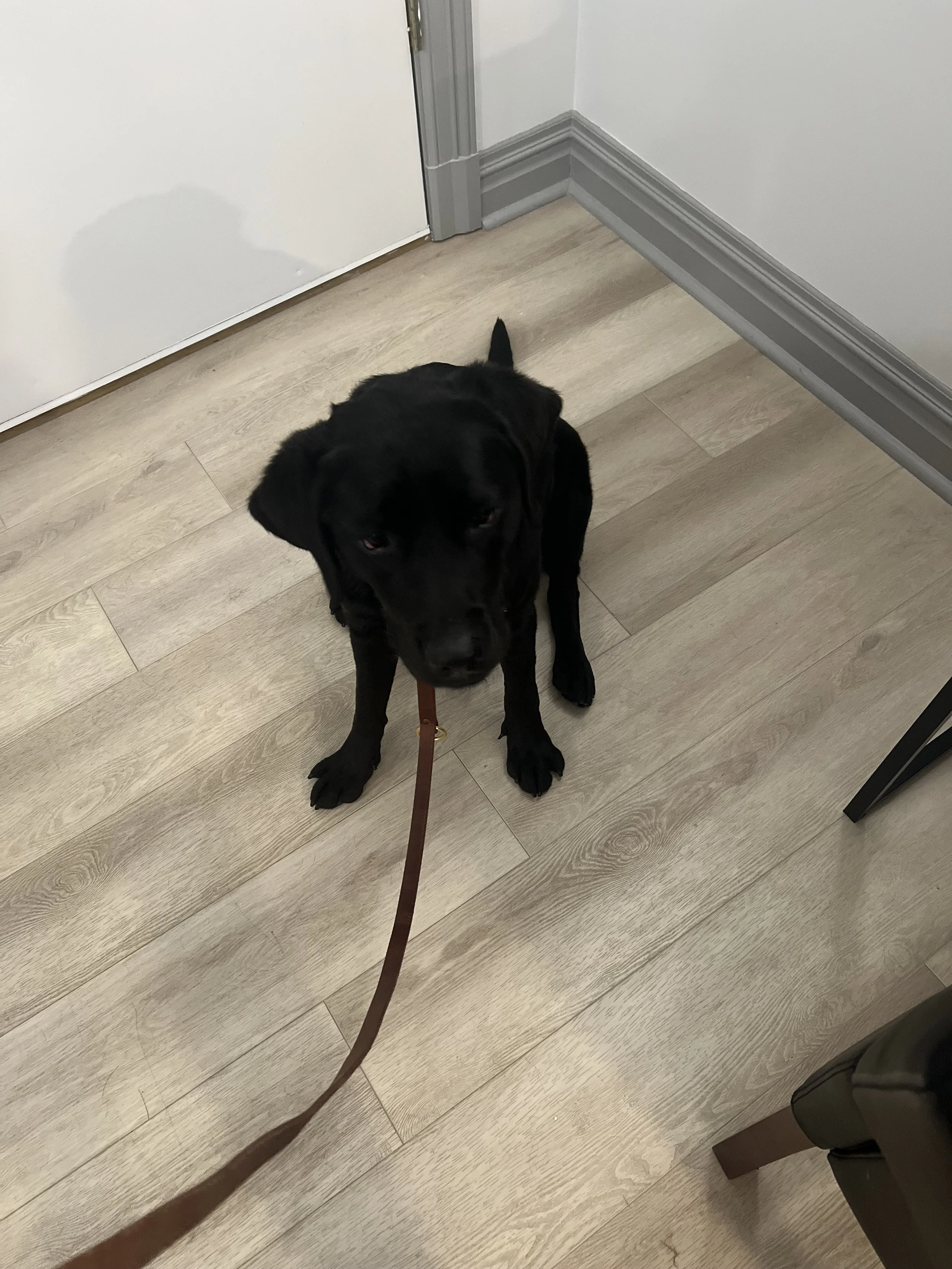
Eve in a sit with a happy expression on her face in our dorm room while in training.
If I have two blind/ low vision children, would they each need to have a guide dog or could they share?
As I was presenting to a group of parents during the 2024 Cane Quest at the Los Angeles Braille Institute this was a question asked. I will give the answer here as I gave then. Yes, each of your children will need a guide dog if they so choose, as each child has a different walking speed and height just to name a few factors.
Can a landlord kick me out if I have a guide dog?
This was a question asked during the Cane Quest Event. No, a landlord cannot refuse a tenant access to having a guide dog because of not allowing pets. A working guide dog is just as much medical equipment as a white cane.
Where can I find a list of Guide Dog schools around the world?
On this Guide Dog Users Inc (GDUI) page it gives a list of guide dog schools in the US. If out of the US this page on the International Guide Dog Federation website gives a greater list of programs.
How do you pick up Eve’s poop?
In class, this is one of the essential skills instructors make sure we’ve mastered before going home. To teach it, they have the dogs go to the bathroom on concrete, so the poop is easier to find and pick up.
We begin by walking about five to ten steps forward before putting our dogs on a long leash. Once the leash is out, we give the bathroom command—depending on the program, this may be “Get busy” or “Park time.” After the command, the dog will sniff around to find the perfect spot. During this time, it’s important for the handler to plant their feet and stay still so they don’t lose orientation.
When the dog stops moving, the handler reaches down to feel the dog’s back. A straight back means the dog is peeing; a curved back means they are pooping. If the dog is pooping, the handler prepares the bag quickly, keeping their feet pointed toward the poop and staying at about an arm’s length away for easy access.
To pick up the poop, the handler opens the bag and places their hand inside, using it like a glove. After picking everything up, they tie off the bag. Once finished, the handler puts the dog back into harness. We’re advised not to let dogs relieve themselves while in harness, as it can confuse their working cues.
Finding a trash can varies depending on the dog. Some dogs can be trained to locate trash cans through methods like back-chaining and generalization, but not all can perform this task. If the dog isn’t able to find a trash can, the handler may ask someone nearby or rely on their knowledge of the area—especially if the trash can is kept in a consistent location.